BACKSTORY (July 24, 1966 —Present): New Orleans Square is exclusive to Disneyland, based on 19th century New Orleans. At the opening, Walt Disney made then-mayor of the real New Orleans, Victor H. Schiro, the mayor of New Orleans Square. Before New Orleans Square was built, Holidayland stood in its place. When it was designed, New Orleans Square was meant to be a perfect square, although now it is difficult to determine where New Orleans Square ends and Frontierland begins (Frontierland’s original New Orleans section is where the River Belle Terrace building is currently located).
This area contains two of the most popular Disneyland attractions: Haunted Mansion and Pirates of the Caribbean. The exterior of the Haunted Mansion was actually constructed in 1962, but Imagineers took several years to develop the attraction. The completed ride opened on August 9, 1969. Pirates of the Caribbean opened March 18, 1967.
Morse code can be heard from the telegraph at the train station in New Orleans Square. The transmission is the first two sentences from Walt’s opening day speech on July 17, 1955: “To all who come to this happy place, welcome. Here age relives fond memories of the past, and here youth may savor the challenge and promise of the future.” This area has featured live jazz music since its inception, including The Royal Street Bachelors and Delta Ramblers. The Side Street Strutters have performed weekly since 1985. Teddy Buckner and His Jazz All-Stars were regulars in the ’80s. Teddy was often mistaken for Louis Armstrong and even played him once in a film. His famous band was busy entertaining the generals and VIP’s in WW2. In 2006, the French Market restaurant featured the Jambalaya Jazz Band, including a live singer “Queenie,” who also performs outside the Disney Gallery several times a day. The Bootleggers pirate band also performs nearby.
New Orleans Square also features some of the nicest restaurants, including The Blue Bayou, which overlooks part of the Pirates of the Caribbean attraction. It features cajun-style food in a fine dining atmosphere. In addition there is also Café Orléans and The French Market & Mint Julep Bar (non-alcoholic). And let’s not forget Club 33.


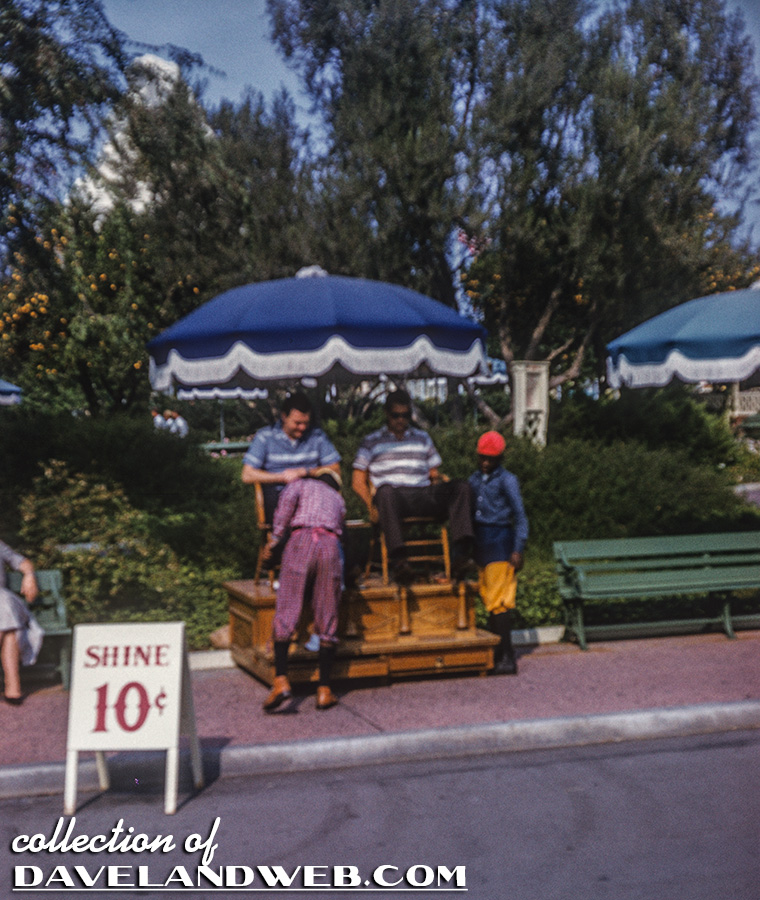
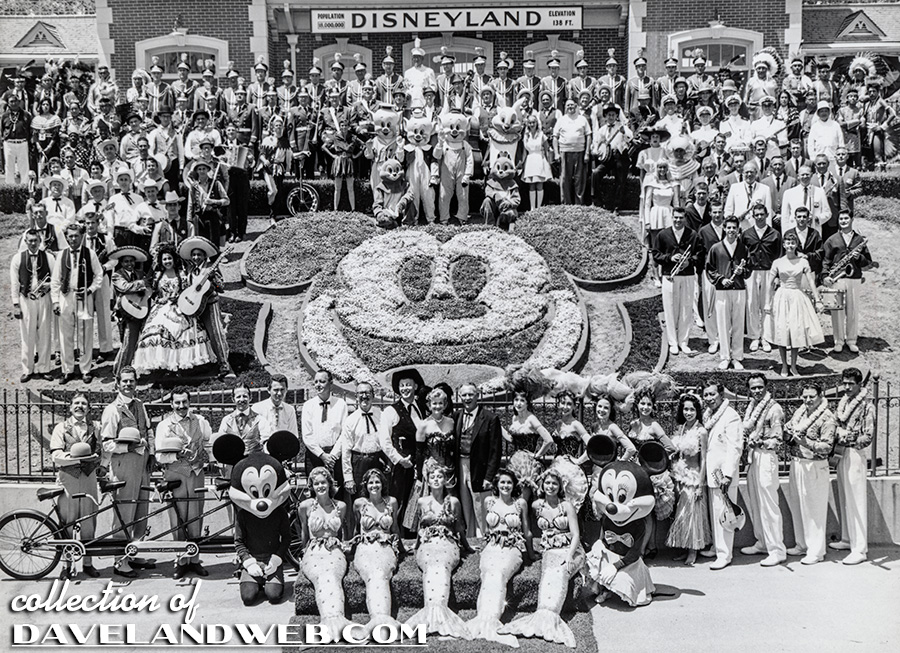
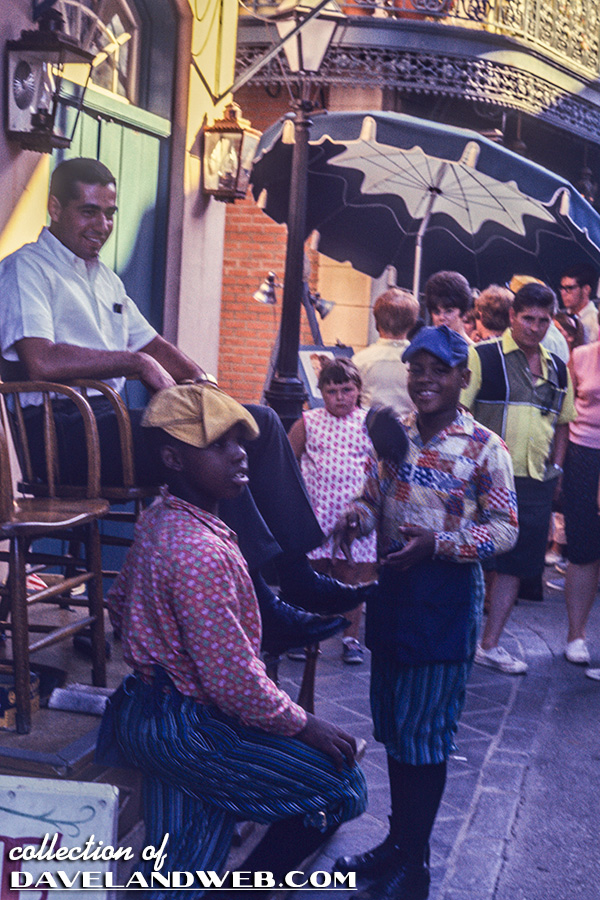
I was contacted by Teddy, of Teddy & Kenny shoeshine boys fame at Disneyland. He came across these photos of himself from the early days of New Orleans Square. Here's what he had to say:
I was blown away when I stumbled across this picture of me (Teddy Miller) with the Royal Street Bachelors, around 1966/67 (group below, 7th photo). The four years I worked at Disneyland were very memorable. I can tell you I really enjoyed those four years of my youth, until I outgrew the character and moved on to become one of the costumed Three Little Pigs for a short while.
I remember Kenny Bell the other shoeshine boy and I were the youngest Disneyland employees; we had free run of the place, like it was our personal playground. We would get to ride all the rides for free, especially the Autopia before the park opened. The Royal Street Bachelors kept us out of trouble, cautioning us about not spending all our tips on junk. Most of mine was spent in the Magic Shop on Main Street, before New Orleans Square was built.I also had a parallel career as a child actor. I was in such classic television shows as "Ozzie and Harriet," "My Three Sons," "The Fugitive," "The Lucy Show," "Mission Impossible," "Family Affair," "Mod Squad," as well as the Rex Harrison movie, "Dr. Doolittle."With Disneyland's proximity to Camp Pendleton and admiring all of the Marines and other service members visiting the park, I was inspired to become a soldier. Thanks for capturing the memories.





How fantastic would it be to hear from someone who was actually in one of my vintage photos? Let me tell you...purty darn fantastic! I recently I was contacted by Mike Willis (aka Dr. Mike) who was searching the internet getting his fix for vintage Disneyland (where he used to work) and stumbled onto my site.
"I worked in the character department (Goofy, Orange Pig, Captain Hook, the front and back of Colonel Hatti (not at the same time), Brer Bear, Mad Hatter…well, the list goes on and includes that my brother (John Lopez) and I were the two that wardrobe used to model Baloo and King Louie on and we then traveled around the country on the MM 1 turbo-prop 12 seater to promote Jungle Book. We had a ton of pictures taken of us at events.I did find the Brer Bear/Fox pic in New Orleans Square with the two shoe shine dancers (1968). If you look at that photo, just to the right of the kids there is a guy with a note book. That is Walt White, a character Lead and good friend of mine back in the day. That photo is of me (BB) and the Fox is my step brother John Lopez. How cool is that?!!"
I'd say purty darn cool Mike! Thanks for sharing! I knew that the guy with the notebook tucked under his arm had to be a cast member! He seemed to be walking with a purpose in mind.

 I love(d) both Mlle. Antoinette's Parfumerie and the Cristal d'Orleans shop.
I wasn't much on perfume, and my Mom was a confirmed Avon devotee, so she didn't care; however the notion of blending an exclusive scent was fascinating. I went in to Mlle. Anoinette's on my last trip and was disappointed to see it look like Needless Markup or the Duty-free shop at the airport. Sigh. It's so strange how it went from "Blend your own scent, be unique" to "Buy a Celebrity scent, smell like someone else." The Britney Spears perfume smelled like Chee-Tos and Menthol cigarettes.
The glass and crystal was equally engaging at the Cristal d'Orleans shop. Mom loved this stuff and had a lot of "depression glass" etc. the fussier and more ornate, the better. She could spend an hour in here each trip. There are several pieces in that window closeup which very much resemble things we had at home (not purchased in this shop). I still have some of them today. I much prefer crystal to silver since it doesn't require polishing.
I visited this shop in the year of your photo on one of my high school ventures with the intent of getting a personalized cup or mug and realizing that I was far too poor to have anything like that. I settled on a mug with a silk-screened Mickey. It's here on my desk as I write, filled with pens.
I agree, the crystal shop is a rare opportunity to get beyond the plush toy and keyring marketing into some very interesting things, not easily found elsewhere, in or out of Disneyland. The architectural detailing of both shops is marvelous, a tour de force of moldings and trim like a walk-in wedding cake. I could stare at that for hours.


They're Not Getting Older...They're Getting More Valuable!

 The shop is small, situated on a well-traveled corner. The French doors, opened wide, reveal a decor best described as "creative clutter." Upon entering, you are confronted with a large, ornately carved dining set Austrian, circa 1860. The tabletop hosts a variety of brass -- door knockers, candlesticks, bells and statuettes. In display cases throughout the shop you see English China, Italian porcelain and German bisque. One nook houses an elaborate bedstead of the '30's.
The scene could be the interior of any of a number of quality antique stores, except for one thing -- location! That "well-traveled corner" is right here in Disneyland, and this unique antique collection resides in our overt own One Of A Kind shop in New Orleans Square.
Besides being one of the most interesting of our merchandise locations, One Of A Kind is probably the most famous outside the Park. Stage Supervisor Jack Onyett commented that "people will often come out to Disneyland for the sole purpose of acquiring something from this shop. Either they've been here before, to look, and now are back to buy, or they've heard that we have something of interest to them."
The buyer in charge of keeping One Of A Kind a tempting lure to antique buyers is Hildegard Webster, a Cast Member since 1961. Her realm also includes the Gold and Silver shops, the Parfumerie and Le Gourmet.
Although One Of A Kind is themed primarily to European antiques (you'll find some early American oak in this group), all the buying is done on this side of the Atlantic. Hildegard is naturally reluctant to reveal her sources, but she will admit that she sticks pretty close to the L.A. and Orange County areas, and "attends a lot of auctions."
At one time, buyers did cross the ocean to search for their treasures, but in the long run this just wasn't practical. "Now," says Hildegard, "the merchandise is close at hand and it enables me to look on year-round basis."
The items vary in age, price and description from alabaster eggs selling for $1.50 each to washstands priced at $650, to the nine-piece dinette set the recently sold for $5900!
The oldest are sets of 18th Century microscopes and nautical instruments. There is even an optometrist's kit from the late 1800's, complete with measuring devices and lenses still intact. But New Orleans Lead Pat Cannon and Hostess Joani Magin agree that the most fascinating item they've yet encountered was the elaborate Gregorian Chant Book dated 1607!
It's interesting to note, too, that even here in the land of antiques there are some endangered species, clocks are getting scarce and the prices have become prohibitive. The ones now available in One Of A Kind are in excellent condition and are very modestly priced.
Although some reproductions are handled, notably chandeliers, needlepoint pillows and bell pulls, the majority of the articles, and all the furniture, are genuine. "One of a kind" in merchandise, this cozy corner also has some "one of a kind" challenges. For instance, when a large hutch or dining set is purchased, nearly the entire shop has to be dismantled to remove it. From New Orleans, it goes to the Warehouse for pick-up or delivery. Since this procedure has to take place after operating hours, it means that at 5:00 the next morning, Hildegard, a stock person and a Lead must attempt to groom the disheveled shop before the Park opens. According to everyone who has ever been involved, "It's a disaster when we get here! If you've never seen it, you can't even imagine it." But they've never failed to finish on time! "One of a kind"...it implies the unique, the unusual, the out-of-the-ordinary, from odd to awesome. But to us here at Disneyland, One Of A Kind is that most charming corner shop in New Orleans that knows the beauty of age.
NOTE: The photo shown at top left is from December 7, 1969.


