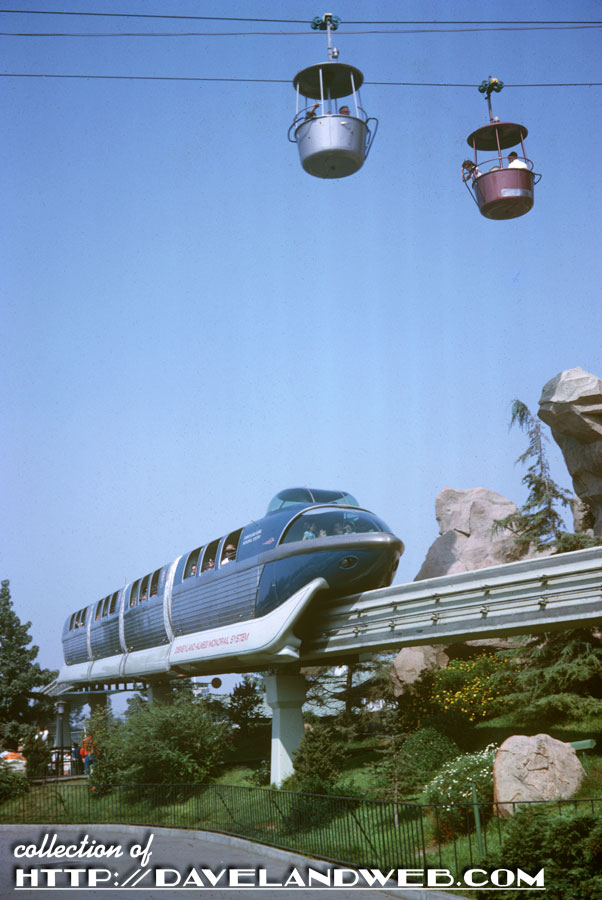
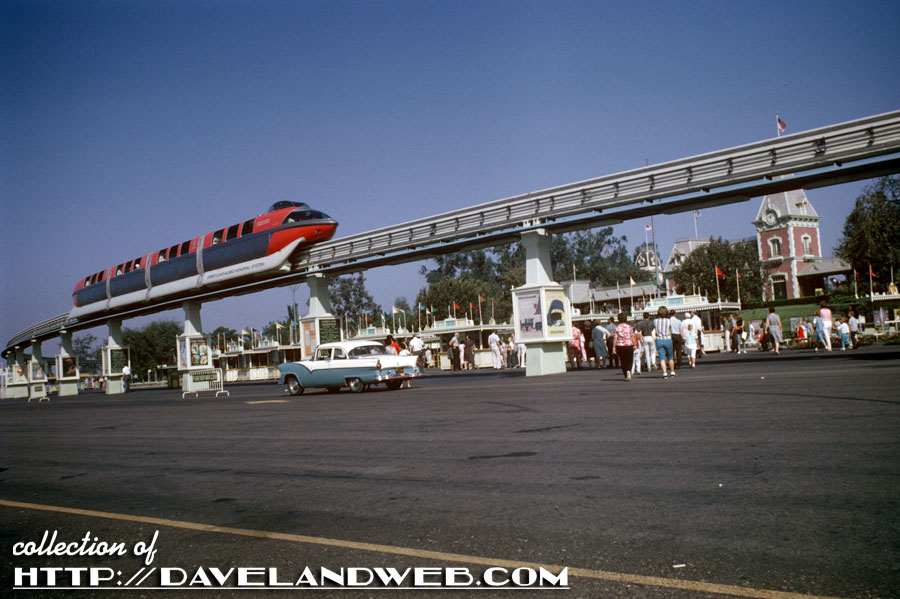
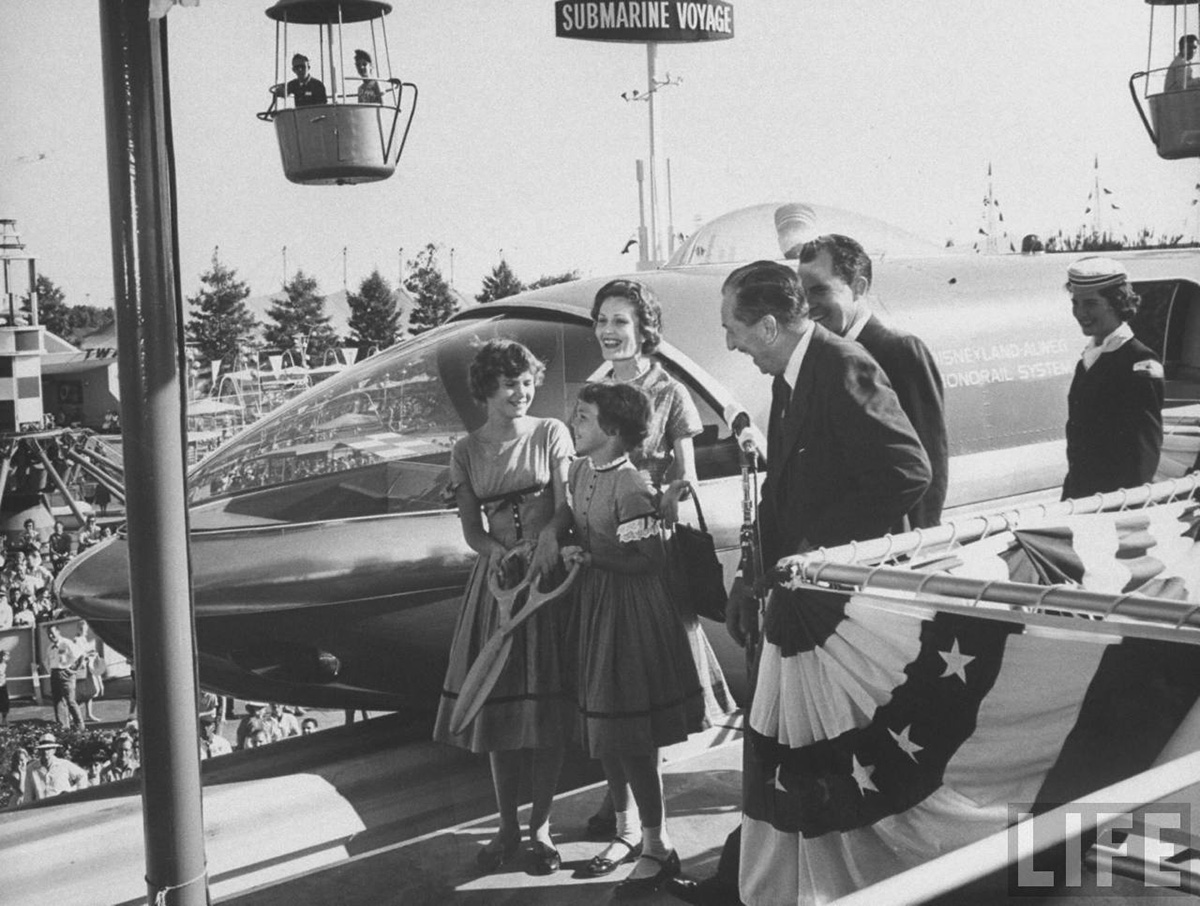
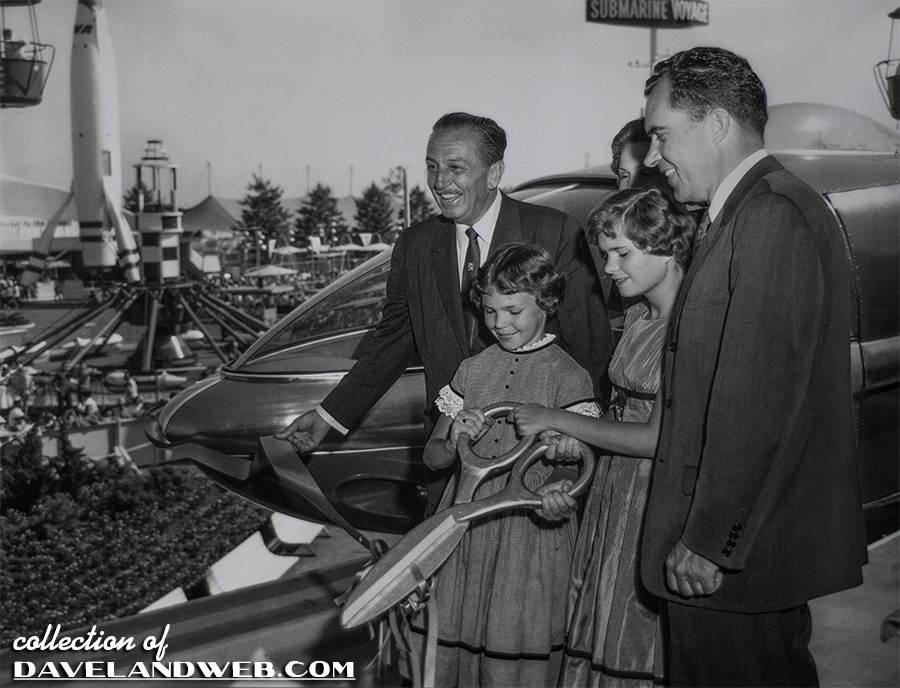
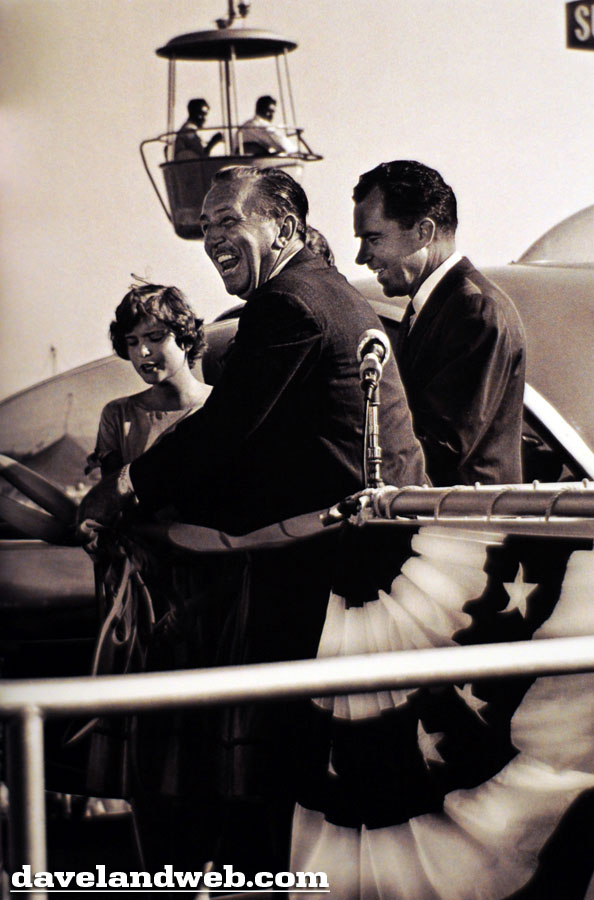
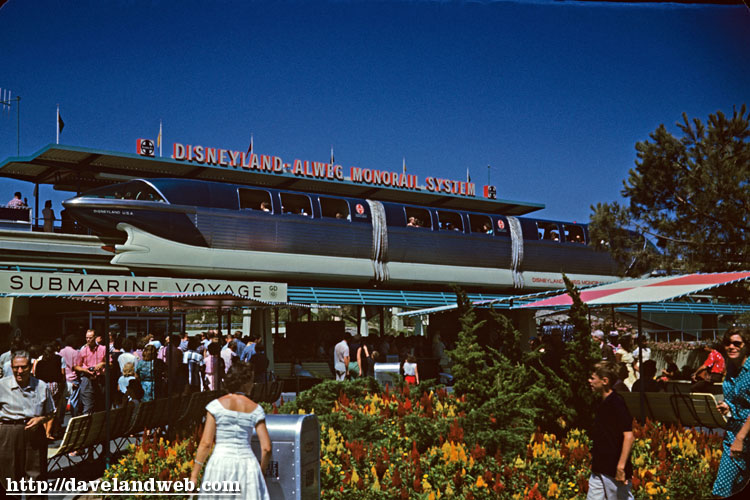
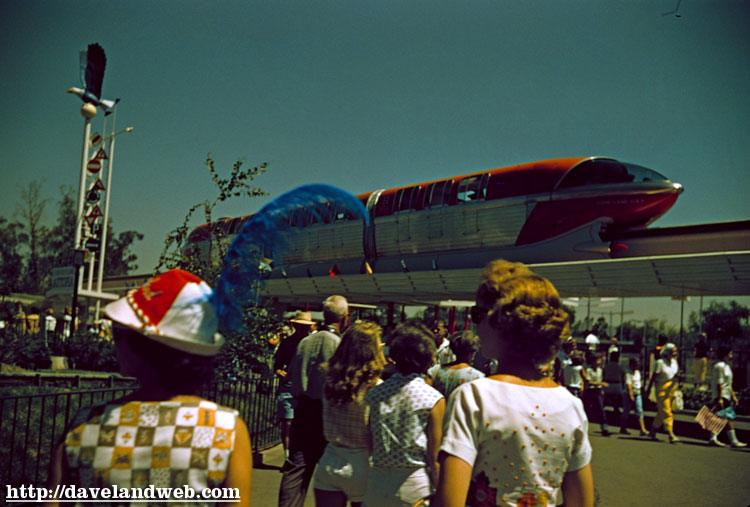
BACKSTORY (June 14, 1959—Present): First daily-operating monorail train system in the Western Hemisphere. The German ALWEG company developed a working monorail prototype, which caught Disney’s eye in 1957. He worked out a deal with ALWEG in which his designers would develop a monorail using ALWEG’s basic design as the starting point. Disney’s young genius, Bob Gurr, designed a sleek train with a rocket-ship nose, stainless steel side panels, and the famous front bubble top. The Disneyland Monorail’s appearance was a complete departure from the plain, functional design of ALWEG’s prototype (or ALWEG’s later Seattle Monorail, built for the 1962 Seattle World’s Fair). Dedicated with a ribbon cutting ceremony that included V.P. Nixon & family.
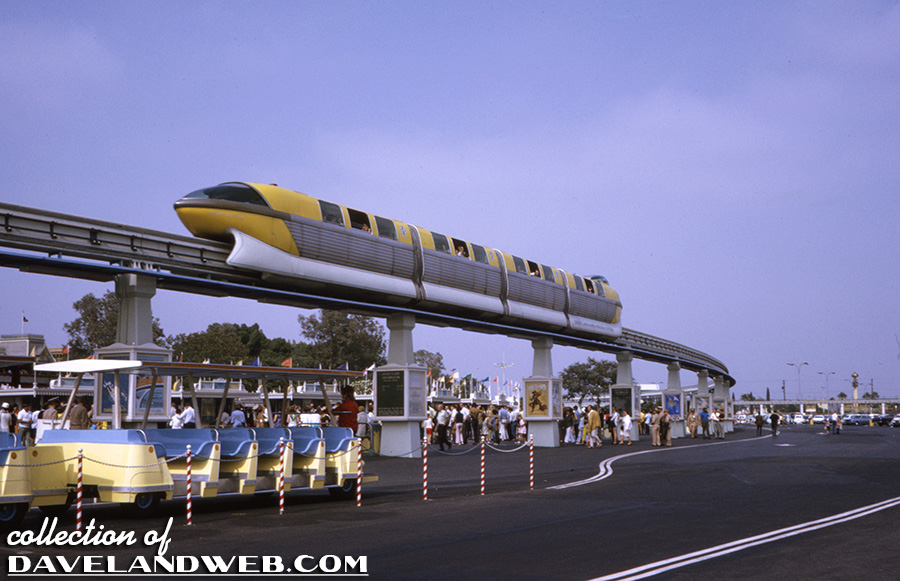
In June 1961, the Monorail became a true transportation link. With an extended 2.5 mile track, Disneyland Hotel guests could board the Monorail at the hotel and begin their park visit in Tomorrowland. Disneyland Park guests could exit at the Disneyland Hotel to drink beverages at the Monorail Lounge that weren’t readily available in the park. Guests had the option to purchase two different types of tickets: the traditional ticket to Disneyland park (disembarking in Tomorrowland) or they could stay on for a round trip. Not only was the track extended, but trains grew from three cars to four cars and the fleet grew to three Mark II trains with the addition of a yellow Monorail.
And an article from the April 1961 "The Disneylander" Newsletter:
MONORAIL NEARS COMPLETION: SCENE CHANGES DAILY
The busling Monorail construction program is speeding to the completion date of June 1st in the jungle of concrete pylons and beams, cranes, pits and barricades throughout the parking lots of Disneyland and the Hotel.
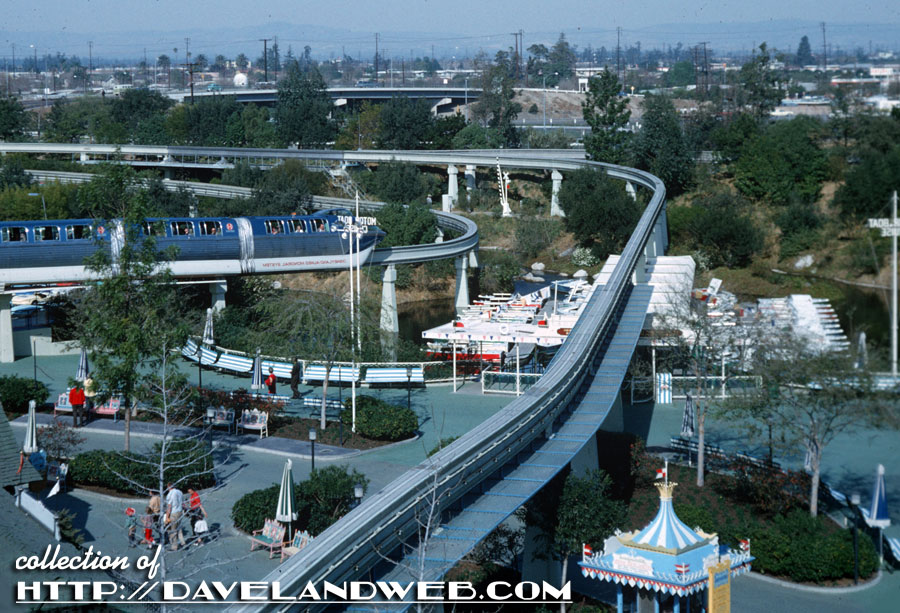
Progress in the past four weeks has been tremendous. Less than half a dozen of the 200 pylons of the extended system remain to be installed. Then the tie-in with the present Monorail will complete the two and one-half mile loop from Tomorrowland to the Hotel and return.
On April 10th the present Monorail will be shut down to complete the tie-in and when completed about May 1st, the new Gold four car train will begin its series of test runs over the entire system.
During the shut-down period the additional spur lines and new service shed that are necessary will be completed and the present Red and Blue trains will undergo major electrical changes and one more car will be added to each.
Work on the West Street divider is progressing rapidly and the landscaping crews are set to begin the job facelifting and beautifying of the entire length of the extended Monorail course following Easter vacation.
Within the next four to six weeks it will be difficult to remember the maze of construction obstacles we've become accustomed to and in its place will be another beauitful and exciting addition to the Disneyland scene.
Many feel that even some of the local die-hards who have never been inside Disneyland will be so intrigued with what they see, skimming through the air on a ribbon of concrete, they will finally come inside the berm.
Here’s another publicity blurb from the Disney folks:
ANAHEIM, Calif., May 26—DISNEYLAND MONORAIL EXTENDED—Motorists traveling along Harbor boulevard in Anaheim, Calif., get a possible foretaste of the future as a train rolls over the extended Disneyland-Alweg monorail system. More than a mile and a half of concrete beamway has been added to the line, connecting Disneyland hotel with the amusement park. The monorail is the first in the U.S. to run adjacent to a major traffic artery.
Disneyland had a contract with Alweg which required the Alweg name to be displayed on the monorail. This conflicted with the Santa Fe contract stating only their name could be associated with railroad attractions, thus causing a rift between Disneyland & Santa Fe.








MONORAIL TO LINK PARK WITH HOTEL
The addition to our Disneyland-Alweg Monorail System that will transport guests between the Disneyland Hotel and the Park is making rapid progress and will be the first passenger carrying monorail in America to run adjacent to a major highway.
Connecting to our popular Monorail in Tomorrowland, the new link will go over the berm, run south along Harbor Blvd. to the auto entrance, turn west across the parking lot and go over West St. to the Disneyland Hotel. Here is will stop to dishcharge and pick up passengers, then return by passing Holidayland and the Park's main entrance, go over the employee entrance and back into Tomorrowland where it will complete its trip over the original route.
Guests will be able to board the Monorail from either the new station at the Hotel or the present station in Tomorrowland. Total length of the round trip will be nearly 2 1/2 miles as compared to about 3/4 of a mile on the present attraction.
Being constructed at present are 700 holes, 24" in diameter and 30 ft. deep, which are filled with concrete and reinforcing steel. These will be the foundation for the pylons supporting the 200 additional sections (8,600 ft. ) of beamway for the extended "highway in the sky."
The next four months will see many changes in the face of the Magic Kingdom. The Heliport has been temporarily re-located just north of the main auto entrance, we will have our own "stack" (3-level variety) where the Monorail crosses itself and the mainline Santa Fe and Disneyland Railroad. The Holidayland boundary on the south side will be changed somewhat to accommodate the new beamway. Our main entrance will also have a completely new look with the addition of a canopy under the Monorail beam.
The parking lot will have a beautiful new face with base plantings surrounding the pylons at each isle along the Monorail route as well as in the center of West Street. Our landscape artisans will also be busy with overall beautification that will put the final Disneyland touch to the completed project.
The complete Monorail extension, which will open to the public about June 1st, will have a third train and an additional car on each of the present trains bringing the capacity of the three up to a total of 318 people, nearly double the present capacity of 164.
Disneyland employees are proud of the fact that they are Disneylanders for many reasons and the present pace setting Monorail extension, which has created world-wide interest, is just one more example.
DISNEYLAND SKYLINE RAPIDLY CHANGING
Tremendous progress has been made on the Monorail extension this past month. Of the 200 pylons that will be needed for the extended system to the Disneyland Hotel about 100 have been installed and many of the beamways are already in place.
The new station at the Hotel is well along in construction and about April 10th the Tomorrowland section will be shut down, along with the original Autopia, to make it possible to tie-in the original system with the extension, according to John Wise, Disneyland engineer.
The speed with which the works is being accomplished should make it possible to test the entire system around the first of May and have it operating for Disneyland and Hotel guests soon after.
Employees and guests have enjoyed watching the progress and some say they will even miss the parking lot obstacle course when all the temporary fences are taken down.
Here is the text from the Live Narration of a Guided Tour, circa 1962 (previously started on this page):
MONORAIL
Before we glide off on the Monorail train, I would like to call your attention to the Disneyland rocket ship behind us which will take you on an interesting and exciting simulated flight to the moon. The rocket is 80' high and was built at the Disney Studios in Burbank under the technical direction of Dr. Werner von Braun. This is a scale model of what an actual rocket to the moon might look like in the future. It is interesting to note that Dr. von Braun helped develop simulated space flight for Walt Disney before he worked on such activities for the United States Government.
Over there is the Autopia, the freeway of the future. These cars travel 850,000 miles each year! Each car has a four gallon gas tank that will run for 12 hours continuously wihtout refueling! Directly in front of us is the submarine ride. Here at Disneyland we have one of the world's largest submarine fleets, each named after one of the ships in the United States Atomic Powered Fleet. Here you may journey through the graveyard of sunken ships, under the polar ice cap, past the lost continent of Atlantis, and witness an underground volcanic eruption. Our submarine fleet travels approximately 20,000 miles each year. We are now going to have an itneresting experience on the first daily operating Monorail train in the Western Hemisphere—The Disneyland-Alweg Monorail system. These futuristic trains, electrically operated and each holding 102 passengers, are now in the planning stages for high speed urban transportation in several large cities throughout the United States. Our trip will take us along the 2.5 miles of elevated beamway to the Disneyland Hotel and back here to Tomorrowland for an exciting aerial view of the entire area. Please follow me as we take the ultramodern speedramp to the Monorail Landing…watch your step.
To resume your vintage tour, please go to the Tomorrowland page.